

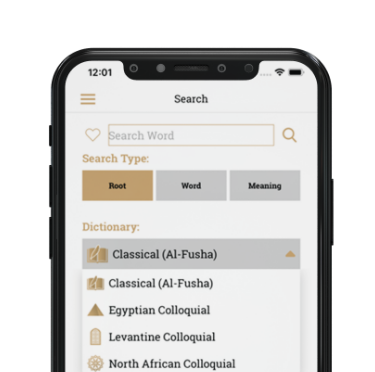
Want to take The Living Arabic Project's dictionaries wherever you go? Download the mobile app Lughatuna! It costs a little bit, but purchasing it supports the project so more cool dictionaries and new features can be added.


This site is always growing. What started out as a simple word list on a student’s desktop has evolved into two of the largest dialect dictionaries ever written for the Egyptian and Levantine dialects with plans for additional dialects and a growing Classical Arabic (Fusha) dictionary, all run on a uniquely structured database designed for Arabic’s diglossia. To make it practical and accessible, there are apps and learning resources appropriate for all levels of users.
Reč u ovom kontekstu (iako tehnički znači "klesar" ili "skulptor") u žargonu titlovanja često označava precizno, vešto izrađen prevod — poput vajara koji kleše reči. Upravo takve prevode zaslužuje opus Tinto Brassa, gde dijalog nije samo funkcionalan, već poetičan, često ciničan i duboko ironičan.
The motif of the sculptor or the artist is a recurring element in this filmography. The act of artistic creation is often used as a parallel to the cinematic gaze; just as a sculptor works with physical materials to shape a form, the camera lens explores the human figure. This perspective is evident in works from the 1990s and early 2000s, where the focus shifted toward a more celebratory and bright visual style. During this era, the lighting and framing often mirrored a classical appreciation of the body, treating it with the same reverence one might find in a gallery or an art studio.
Arabic is hard and complex, but also rich and deep. Imagine learning tools that map out Arabic for you and help you learn it. That’s what this site is. It has dictionaries for Egyptian, Levantine, and Classical Arabic, and it has apps and learning resources to help you access the language.
These dictionaries are more than just a list of words, they are guides to the Arabic language. The uniquely structured database allows users to search by Arabic word, English word, and Arabic root. There are also thousands of examples to show users how to properly use words and listing common phrases and proverbs.
Reč u ovom kontekstu (iako tehnički znači "klesar" ili "skulptor") u žargonu titlovanja često označava precizno, vešto izrađen prevod — poput vajara koji kleše reči. Upravo takve prevode zaslužuje opus Tinto Brassa, gde dijalog nije samo funkcionalan, već poetičan, često ciničan i duboko ironičan.
The motif of the sculptor or the artist is a recurring element in this filmography. The act of artistic creation is often used as a parallel to the cinematic gaze; just as a sculptor works with physical materials to shape a form, the camera lens explores the human figure. This perspective is evident in works from the 1990s and early 2000s, where the focus shifted toward a more celebratory and bright visual style. During this era, the lighting and framing often mirrored a classical appreciation of the body, treating it with the same reverence one might find in a gallery or an art studio.
Do you have questions or comments?
Feel free to reach out through Contact us page.
