![[HOME]](https://ftp.funet.fi/index/Tree_of_life/icons/home.gif)
![[INDEXES]](https://ftp.funet.fi/index/Tree_of_life/icons/warp.gif)
![[TREE]](https://ftp.funet.fi/index/Tree_of_life/icons/phylo.png) Life
Insecta
Lepidoptera
Ditrysia
Noctuoidea
Noctuidae
Xyleninae
Life
Insecta
Lepidoptera
Ditrysia
Noctuoidea
Noctuidae
Xyleninae
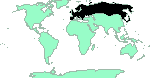 EU - Russia, Japan. See [maps]
Vielzahn-Johanniskrauteule
Purple Cloud
Hammaskuismayökkönen
EU - Russia, Japan. See [maps]
Vielzahn-Johanniskrauteule
Purple Cloud
Hammaskuismayökkönen
![[polyodon-1.jpg]](https://ftp.funet.fi/index/Tree_of_life/insecta/lepidoptera/ditrysia/noctuoidea/noctuidae/xyleninae/actinotia/_polyodon-1.jpg) 508x559 (~30Kb) Germany, Baden-Württemberg, Schönenberg, Siedlungsbereich (8°49'E, 48°57'N, 250m), 30.07.2001, Photo © Karl Hofsäß
508x559 (~30Kb) Germany, Baden-Württemberg, Schönenberg, Siedlungsbereich (8°49'E, 48°57'N, 250m), 30.07.2001, Photo © Karl Hofsäß
|
![[polyodon-2.jpg]](https://ftp.funet.fi/index/Tree_of_life/insecta/lepidoptera/ditrysia/noctuoidea/noctuidae/xyleninae/actinotia/_polyodon-2.jpg) 834x708 (~126Kb) Russia, Moscow area, 27.7.2010 (36°25'E, 56°23'N), Photo © D. Smirnov
834x708 (~126Kb) Russia, Moscow area, 27.7.2010 (36°25'E, 56°23'N), Photo © D. Smirnov
|
![[polyodon.jpg]](https://ftp.funet.fi/index/Tree_of_life/insecta/lepidoptera/ditrysia/noctuoidea/noctuidae/xyleninae/actinotia/_polyodon.jpg) 500x520 (~44Kb) FINLAND: Ka: Virolahti, 671:53, m+f 10-16.6.1995, Markku Savela leg.
500x520 (~44Kb) FINLAND: Ka: Virolahti, 671:53, m+f 10-16.6.1995, Markku Savela leg.
|
Larva on (in flowers and pods) Hypericum , H. maculatum, H. perforatum [SPRK]
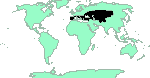 SEU, Turkey, Armenia, Turkmenistan, C.Asia. See [maps]
 N.Vietnam. See [maps]
 Borneo, Sulawesi. See [maps]
 W.Turkestan. See [maps]
 Madagascar. See [maps]
11.6.2023 (9)
Have you ever found yourself in a situation where you couldn't help but be drawn to something that you knew you shouldn't be looking at? Maybe it was a glimpse of a celebrity in a vulnerable moment or a stranger who caught your attention in a public place. The phenomenon of "ngintip cewek cantik mandi" or "peeking at a beautiful girl taking a shower" is a common trope in popular culture, but what drives this curiosity?
The phrase "ngintip cewek cantik mandi" (literally translating to "peeping at a beautiful girl showering") refers to the act of voyeurism, which involves secretly observing someone without their consent as they go about private activities. This behavior is not only unethical and illegal in many jurisdictions but also deeply invasive of personal privacy and respect. Below is a critical review of the concept and its implications: ngintip cewek cantik mandi checked
In this article, we'll explore the psychology behind this behavior, examining the factors that contribute to our fascination with private moments and the implications of this curiosity on our relationships and society. Have you ever found yourself in a situation
: He was arrested and charged under privacy and voyeurism laws. In many jurisdictions, such as Indonesia, this falls under the ITE Law (Information and Electronic Transactions) and the Pornography Law, which carry heavy fines and multi-year prison sentences. : He was arrested and charged under privacy
In today's digital age, the concept of privacy has become more elusive than ever. With the rise of social media and the omnipresent nature of surveillance, both online and offline, the boundaries of personal space are frequently tested. A recent topic of discussion that has emerged in certain circles is "ngintip cewek cantik mandi," which translates to peeking at a beautiful girl while she's showering. This subject might seem trivial or even humorous to some, but it brings to the forefront significant concerns about consent, legality, and the respect for individual privacy.
: The experience can be traumatic for the person whose privacy is violated, leading to feelings of vulnerability, distress, and potentially long-term psychological effects.
Voyeurism, also known as "peeping," is a type of paraphilic disorder characterized by a recurring and intense sexual arousal from observing an unsuspecting person or people who are naked, in the process of undressing, or engaging in sexual activities. While this behavior is considered deviant and can be harmful to others, it's crucial to differentiate between voyeurism as a psychiatric disorder and the occasional, non-invasive, and non-intrusive curiosity people may experience.
Have you ever found yourself in a situation where you couldn't help but be drawn to something that you knew you shouldn't be looking at? Maybe it was a glimpse of a celebrity in a vulnerable moment or a stranger who caught your attention in a public place. The phenomenon of "ngintip cewek cantik mandi" or "peeking at a beautiful girl taking a shower" is a common trope in popular culture, but what drives this curiosity?
The phrase "ngintip cewek cantik mandi" (literally translating to "peeping at a beautiful girl showering") refers to the act of voyeurism, which involves secretly observing someone without their consent as they go about private activities. This behavior is not only unethical and illegal in many jurisdictions but also deeply invasive of personal privacy and respect. Below is a critical review of the concept and its implications:
In this article, we'll explore the psychology behind this behavior, examining the factors that contribute to our fascination with private moments and the implications of this curiosity on our relationships and society.
: He was arrested and charged under privacy and voyeurism laws. In many jurisdictions, such as Indonesia, this falls under the ITE Law (Information and Electronic Transactions) and the Pornography Law, which carry heavy fines and multi-year prison sentences.
In today's digital age, the concept of privacy has become more elusive than ever. With the rise of social media and the omnipresent nature of surveillance, both online and offline, the boundaries of personal space are frequently tested. A recent topic of discussion that has emerged in certain circles is "ngintip cewek cantik mandi," which translates to peeking at a beautiful girl while she's showering. This subject might seem trivial or even humorous to some, but it brings to the forefront significant concerns about consent, legality, and the respect for individual privacy.
: The experience can be traumatic for the person whose privacy is violated, leading to feelings of vulnerability, distress, and potentially long-term psychological effects.
Voyeurism, also known as "peeping," is a type of paraphilic disorder characterized by a recurring and intense sexual arousal from observing an unsuspecting person or people who are naked, in the process of undressing, or engaging in sexual activities. While this behavior is considered deviant and can be harmful to others, it's crucial to differentiate between voyeurism as a psychiatric disorder and the occasional, non-invasive, and non-intrusive curiosity people may experience.
If you have corrections, comments or
information to add into these pages, just send mail to
Markku Savela
Keep in mind that the taxonomic information is copied from various sources, and may include many inaccuracies. Expert help is welcome.